Light Meter Classic

Meter the part of the frame that matters.

A reflected-light meter for film photography.

It uses the phone camera as its sensor, lets you choose exactly which part of the frame to measure, and works out the ISO, aperture and shutter combination to set on your camera — restricted to the values that camera actually has.

It exists for the situations a film camera's own meter gets wrong: a face against a bright window, a subject lit from behind, a stage. Those are exactly the cases where averaging the whole frame throws the exposure away, and where being able to say measure here, not there fixes it.


Measure where you want

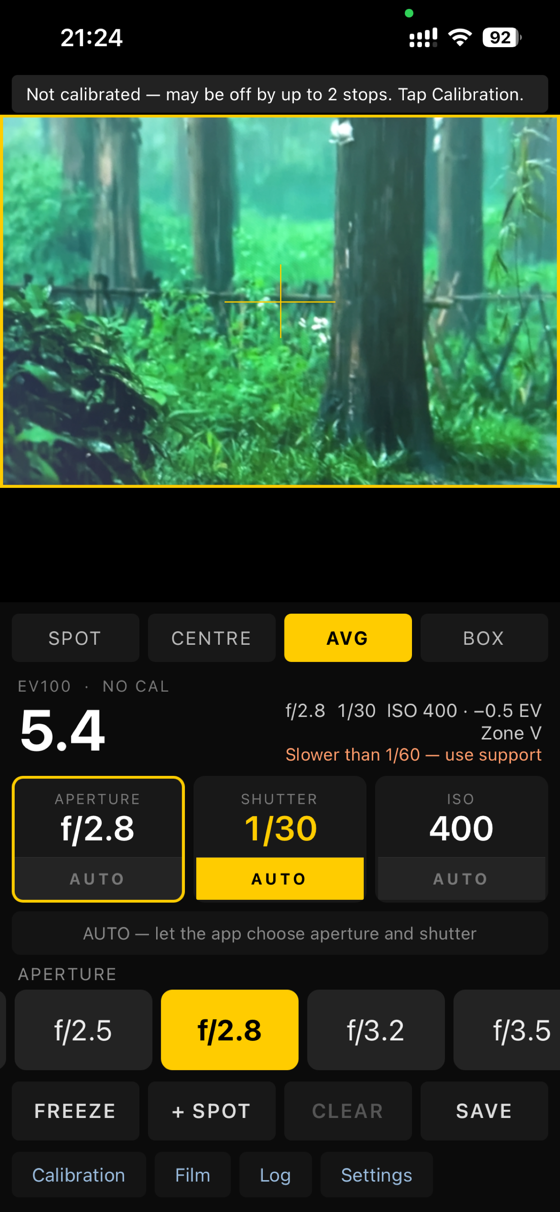
Four patterns. SPOT for a face or a shadow, CENTRE weighted three-to-one towards the middle, AVG for the whole frame, and BOX — drag to move it, drag the corner to resize it.

The preview is a 3:2 window: the frame a 35mm camera gets, whatever the shape of your screen.

FREEZE holds a reading so you can recompose without it changing. Store several readings with + SPOT and the app places the scene midway between its extremes, rather than letting any one reading pull the exposure to middle grey.

The metering screen: a live 3:2 preview with a yellow region marker, EV 5.4, and tiles for aperture, shutter and ISO.

Only values your camera has

One setting is computed and the other two you set by hand. Each tile carries its own AUTO switch — tap it on aperture and the app finds the aperture; tap it on shutter and it finds the shutter. One button hands both over at once.

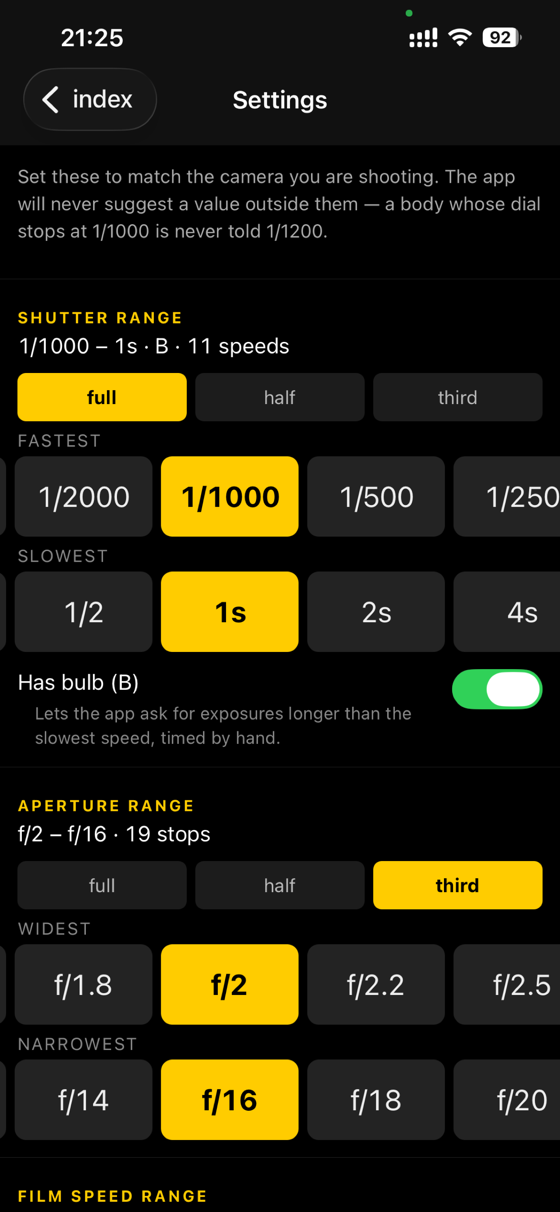
Set the three ranges once — shutter, aperture, film speed — each with its own step size, a bulb switch, and the speed below which to warn about camera shake. A body whose dial stops at 1/1000 is never told 1/1200. That covers any camera and lens without a library of them.

The settings screen, showing shutter range 1/1000 to 1s with bulb enabled, and aperture range f/2 to f/16 in third stops.

Calibrate once, and leave the reference at home

A phone differs from a reference meter by a fixed amount — usually between about two-thirds and two stops. Because it is systematic, measuring it once removes most of the error permanently.

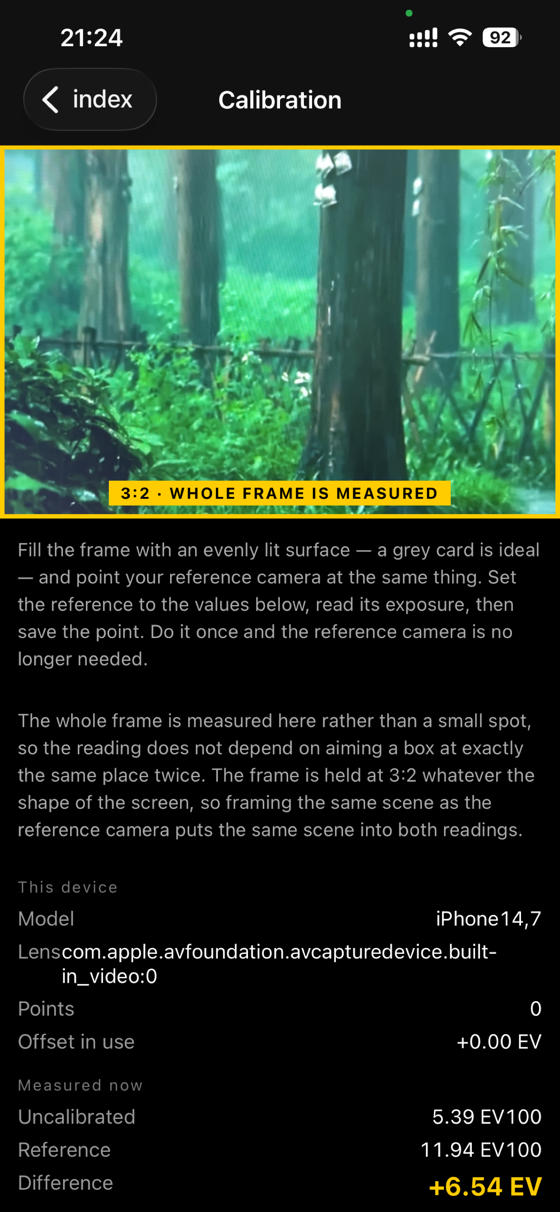
Fill the frame with an evenly lit surface, dial in what a camera you trust reads, and save the point. Check at a few light levels and add a point where it is out. Calibration is keyed to the phone and lens, and exports to JSON so it can be backed up or moved.

No offsets ship for devices that have not been measured. An invented number is worse than none, because it looks like a measurement.

The calibration screen, framing 3:2 with the whole frame measured, showing the device model, lens and the difference against a reference reading.

Reciprocity, only where it is published

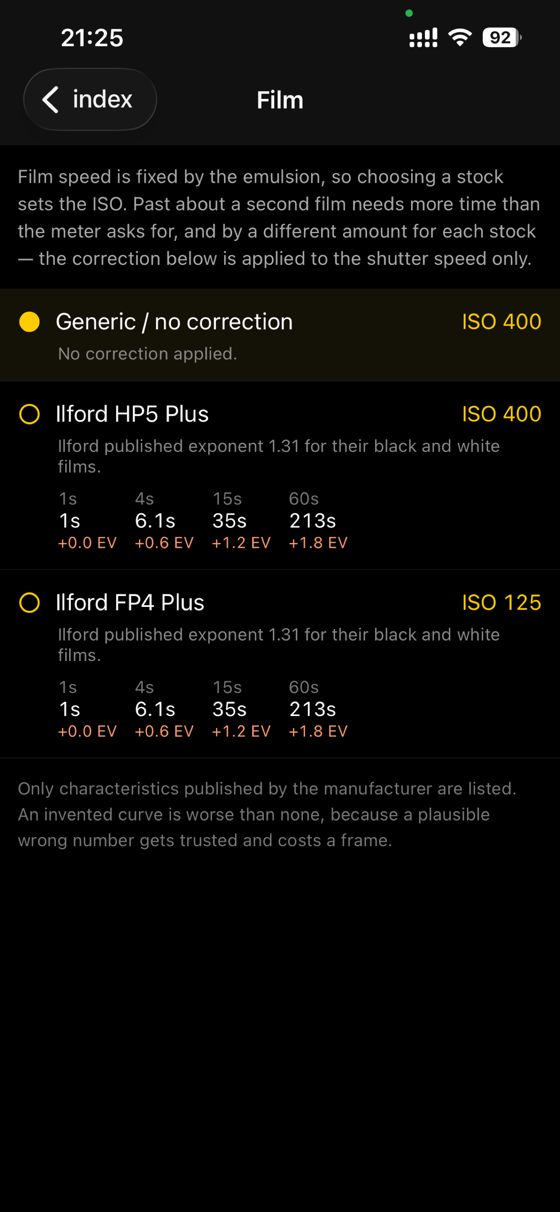
Past about a second, film needs more time than the meter asks for, and by a different amount for each stock. Where a manufacturer publishes the figure, the app applies it to the shutter speed.

Where none is published, it applies nothing rather than guessing. A plausible wrong number gets trusted and costs a frame.

The film screen, listing stocks with their ISO and the reciprocity correction applied at 1, 4, 15 and 60 seconds.

Nothing leaves the phone

No account, no analytics, no advertising, and no networking code at all. Camera frames are read to measure brightness and discarded at once — nothing is recorded, saved to your photo library, or transmitted.

Your settings, calibration and shot log stay in the app's own storage, and go when the app goes. Read the privacy policy.